

Abstract
North Carolina faces an escalating housing affordability crisis driven by rapid population growth, restrictive zoning, rising construction costs, labor shortages, financing barriers, and institutional investor activity. Between 2018 and 2024, home prices in the state rose more than 80 percent, while extremely low-income renters confronted a shortfall of over 200,000 affordable units. This paper examines the structural drivers of the crisis—including exclusionary land-use practices, elevated material costs, skilled workforce deficits, mortgage access constraints, and the financialization of housing—and evaluates policy responses that balance deregulation with public protections. Evidence from both national research and state-level programs suggests that targeted reforms such as zoning modernization, streamlined permitting, and expanded apprenticeship programs can deliver near-term relief, while building code updates and investor oversight provide mid- and long-term solutions. By aligning supply- and demand-side measures, North Carolina can restore affordability, expand access to secure housing, and sustain economic competitiveness. The analysis concludes with a policy framework that prioritizes zoning reform, digital permitting, workforce development, and institutional regulation, establishing measurable benchmarks for reducing cost burdens and expanding housing supply.
Introduction
North Carolina is facing a housing affordability crisis that is both structural and urgent. Urban centers such as Charlotte, Raleigh, and Durham are experiencing escalating prices due to rapid in-migration, underinvestment in affordable housing, and restrictive zoning practices.[1] Over one million people are projected to move into the state within the coming decade, adding pressure to an already constrained housing supply. National data reflects similar concerns, with the Federal Housing Finance Agency reporting an 80.6 percent increase in North Carolina home prices between Q2 2018 and Q2 2024. At the same time, extremely low-income renters in the state face a shortfall of over 207,000 affordable and available units, according to the National Low Income Housing Coalition. This crisis requires a multi-dimensional response that addresses zoning rigidity, material costs, skilled labor shortages, financing barriers, and the growing role of institutional investors in the housing market.
Factors Driving the Crisis
The causes of North Carolina’s housing shortage are varied but interconnected. Zoning laws remain one of the most significant barriers, with exclusionary zoning ordinances limiting the construction of multifamily housing, accessory dwelling units (ADUs), and missing-middle options such as duplexes and townhomes. Research by economist Edward Glaeser and Joseph Gyourko demonstrates that restrictive land-use rules are strongly associated with higher home prices and constrained supply,[2] while the Brookings Institution (2021) found that jurisdictions adopting zoning reforms experience faster growth in housing stock and slower rent increases.[3]
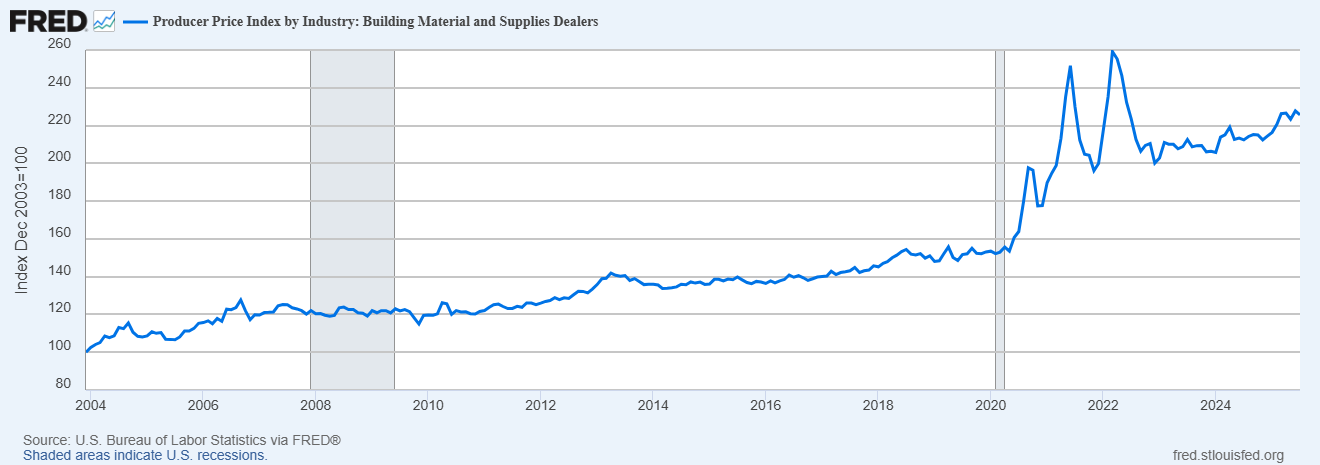
Material costs further exacerbate the problem. Since 2020, the Producer Price Index for building material dealers has risen more than 40 percent.[4] Even as inflation has moderated, these costs remain well above pre-pandemic baselines, putting sustained pressure on developers and reducing the feasibility of marginal housing projects.
Compounding cost pressures is a looming skilled labor shortage. The Associated Builders and Contractors estimate that the U.S. will need more than 400,000 additional construction workers this year alone, with Sun Belt states such as North Carolina particularly vulnerable.[5] Years of emphasis on four-year college pathways over vocational training have left the trades undersupplied, and with large cohorts approaching retirement, the workforce gap threatens to slow construction even further.
Mortgage access has also tightened in the aftermath of the 2008 financial crisis. Regulations introduced under the Dodd-Frank Act, particularly the Ability-to-Repay and Qualified Mortgage rules, strengthened consumer protections but also made it harder for some middle-income households to secure loans. At the same time, rising interest rates—implemented to curb inflation—have pushed monthly mortgage payments beyond the reach of many. In 2023, Redfin reported that homebuyers needed to earn $114,627 annually to afford the median-priced U.S. home—the highest income on record at the time; by 2025, that figure had eased slightly to $112,131, even as the median home price rose to $447,035.[6][7]
Finally, the increasing financialization of housing adds a further challenge. In metropolitan areas like Charlotte, institutional investors now own an estimated 18 percent of single-family rental homes.[8] Research by the Philadelphia Federal Reserve (2023) shows that institutional acquisitions often lead to steeper rent increases at the property level.[9] While investment inflows can expand housing supply in some contexts, in practice they often reduce availability for local buyers and drive up costs.
Setting Guardrails to Establish Sustainable and Scalable Reform
Policy reforms in housing and land use must strike a delicate balance between deregulation and the protection of public interests. While some critics advocate for the wholesale elimination of zoning regulations, such a move is neither feasible nor desirable given zoning’s essential role in safeguarding public health, safety, and environmental quality. For instance, zoning restrictions help separate incompatible land uses and reduce exposure to pollution or hazardous conditions.[10] Instead of dismantling zoning altogether, targeted liberalization can expand housing affordability while preserving community protections. Evidence suggests that policies allowing missing-middle housing—such as duplexes, triplexes, and accessory dwelling units—can diversify housing stock and expand affordability without undermining neighborhood character.[11] Similarly, eliminating excessive parking minimums has been shown to reduce construction costs and expand housing supply, particularly in urban areas where demand is highest.[12]
On the demand side, interventions like tax credits or down-payment assistance remain important tools for expanding access to homeownership, but they must be paired with supply-side reforms. Without corresponding increases in housing production, additional demand-side subsidies risk inflating housing prices, undermining their affordability goals.[13] Balanced policy therefore requires coordinated supply and demand measures. Moreover, modernization of building codes can promote innovation without compromising safety. A performance-based regulatory framework enables cost-saving methods such as modular construction or mass-timber design, both of which have been found to lower construction costs and shorten project timelines while meeting high safety standards.[14][15] By updating codes to emphasize outcomes rather than prescriptive requirements, policymakers can encourage innovation in building practices while maintaining rigorous benchmarks for resilience, fire safety, and environmental sustainability.
Potential Solutions
With guardrails in place, we can now examine policy proposals that fall within a truncated distribution of solutions to ensure policies are measurable, effective, and centered on consensus.
The first near-term reform to focus on is zoning modernization. Allowing duplexes, triplexes, and accessory dwelling units (ADUs) by-right, particularly in transit-accessible corridors and high-opportunity neighborhoods, would unlock new supply without requiring major infrastructure expansion. Such reforms address the structural imbalance between housing supply and demand by creating opportunities for “missing middle” housing. Evidence from Minneapolis, which eliminated single-family-only zoning in 2019, suggests that reforms of this type can expand supply while moderating rent growth relative to neighboring jurisdictions, demonstrating that zoning liberalization can play a measurable role in housing affordability.[16] Other studies have further emphasized that restrictive zoning contributes to higher housing costs and limits socioeconomic mobility.[17]
Streamlining permitting processes is equally critical for housing supply. Long review times introduce uncertainty and raise financing costs, which can make otherwise viable projects infeasible. State-level “shot clocks” on permit approvals and the adoption of digital, one-stop review systems could reduce delays by standardizing timelines and eliminating duplicative procedures. Empirical research demonstrates that shorter approval timelines are strongly correlated with increased housing completions, particularly in high-demand regions.[18] For example, research on California’s housing market shows that excessive approval times exacerbate affordability crises by inflating development costs and constraining output.[19] Digitized permitting, already piloted in several jurisdictions, offers further evidence that modernized review systems accelerate delivery while maintaining regulatory oversight.[20]
The second near-term solution is workforce development. North Carolina’s skilled labor shortage is particularly acute due to the state’s rapid population growth and construction demand. Apprenticeship programs provide a proven solution for addressing these shortages. The state’s ApprenticeshipNC program has seen notable success, with a 45 percent increase in registered apprenticeships and a 50 percent increase in pre-apprenticeships between FY 2023 and FY 2024, indicating rising interest from both employers and participants.[21] Apprenticeships remain vital for connecting workers with high-demand trades while providing businesses with a reliable pipeline of skilled labor. International evidence reinforces this model: Germany and Switzerland’s robust apprenticeship systems have been credited with improving labor supply resilience and overall economic productivity.[22] This suggests that expanding apprenticeship programs in North Carolina could deliver long-term benefits for both housing affordability and economic competitiveness.
The mid-term solution is code modernization. Outdated building codes often raise costs without proportional improvements in safety. For example, requirements such as mandating two staircases in small apartment complexes increase construction costs and reduce buildable floor space, yet studies suggest the safety benefits in lower-rise buildings are limited.[23] In contrast, updating codes to allow modular and industrialized construction practices can reduce both costs and timelines. Research from the Urban Institute highlights that modular and mass-timber construction not only speeds delivery but also contributes to sustainability goals.[24] North Carolina’s adoption of performance-based standards could therefore simultaneously encourage innovation and maintain rigorous safety benchmarks.
The final long-term solution involves regulating housing financialization. Over the past decade, large institutional investors have increased their presence in single-family and multifamily rental markets, often outbidding local buyers and contributing to affordability challenges.[25] North Carolina could adopt policies to discourage speculative acquisitions by such investors, including vacancy taxes to penalize prolonged vacancies, prioritizing nonprofits or community land trusts with right-of-first-refusal on distressed property sales, and requiring greater transparency in investor acquisitions. Research shows that speculative investor activity exacerbates price volatility and reduces long-term affordability, while community land trusts provide more stable, permanently affordable housing options.[26]
Near-term priorities should focus on enacting zoning reforms, launching digital permitting systems, and scaling apprenticeship funding, as these measures can deliver immediate supply-side relief. Mid-term efforts should update state building codes to support modular and mass-timber construction while expanding affordable finance programs such as the Workforce Housing Loan Program. Long-term strategies must center on monitoring institutional investor activity, strengthening land trusts, and publishing quarterly data on housing production, affordability, and apprenticeship completions. Success should be measured through clear metrics: reduced permit processing times, increased housing completions, higher apprenticeship graduation rates, and measurable decreases in the percentage of cost-burdened renters. Together, these reforms represent a comprehensive strategy for addressing North Carolina’s housing affordability challenges in a sustainable, balanced, and evidence-based manner.
Conclusion
North Carolina’s housing crisis is multifaceted, rooted in restrictive zoning, cost pressures, labor shortages, financial barriers, and speculative investment activity. Addressing it requires equally comprehensive solutions. By reforming zoning laws, streamlining approvals, modernizing codes, expanding apprenticeships, and regulating financialization, the state can restore housing affordability and maintain its economic competitiveness. A coordinated policy framework that emphasizes both supply expansion and workforce development offers the best path toward ensuring secure, accessible, and affordable housing for all North Carolinians.
References
[1] Peters, J. (2024, November 23). Affordable housing in North Carolina. North Carolina Forward Party.
Retrieved from https://www.ncforwardparty.com/affordable_housing_in_north_carolina
[2] Glaeser, E. L., & Gyourko, J. (2018). The economic implications of housing supply restrictions. Journal of Economic Perspectives, 32(1), 3–30. Retrieved from https://www.nber.org/papers/w23833
[3] Schuetz, J. (2020, January). To improve housing affordability, we need better alignment of zoning, taxes, and subsidies (Policy Big Ideas). Brookings Institution. Retrieved from https://www.brookings.edu/wp-content/uploads/2019/12/Schuetz_Policy2020_BigIdea_Improving-Housing-Afforability.pdf
[4] Federal Reserve Bank of St. Louis. (2025). Producer Price Index by Industry: Building Material and Supplies Dealers (PCU44414441). https://fred.stlouisfed.org/series/PCU44414441
[5] Associated Builders and Contractors. (2025, January 24). Construction industry must attract 439,000 workers in 2025 [News release]. Retrieved from https://www.abc.org/News-Media/News-Releases/abc-construction-industry-must-attract-439000-workers-in-2025
[6] Anderson, D. (2023, October 17). Homebuyers must earn $115,000 to afford the typical U.S. home. That’s about $40,000 more than the typical American household earns. Redfin. Retrieved from https://www.redfin.com/news/homebuyer-income-afford-home-record-high/
[7] Katz, L. (2025, August 6). Homebuying affordability is improving in these 11 places. Redfin. Retrieved from https://www.redfin.com/news/income-needed-to-afford-home-august-2025/
[8] U.S. Government Accountability Office. (2024, May 22). Rental housing: Information on institutional investment in single-family homes (GAO-24-106643). Retrieved from https://www.gao.gov/products/gao-24-106643
[9] Lee, K., & Wylie, D. (2024, July). Institutional investors, rents, and neighborhood change in the single family residential market (Working Paper No. 24-13). Federal Reserve Bank of Philadelphia. https://doi.org/10.21799/frbp.wp.2024.13
[10] Urban Institute. (n.d.). Land use regulation and approval reforms. In Pursuing housing justice: Interventions and their impacts. Retrieved from https://www.urban.org/apps/pursuing-housing-justice-interventions-impact/land-use-regulation-and-approval-reforms
[11] Been, V., Ellen, I. G., & O’Regan, K. (2019). Supply skepticism: Housing supply and affordability. Housing Policy Debate, 29(1), 25–40. https://doi.org/10.1080/10511482.2018.1476899
[12] Shoup, D. (2021). Parking and the city. Routledge.
[13] Ibid.
[14] American Wood Council. (n.d.). Mass timber. Retrieved August 24, 2025, from https://awc.org/issues/mass-timber/
[15] Ibid.
[16] Kahlenberg, R. D. (2019, October 24). How Minneapolis ended single-family zoning. The Century Foundation. Retrieved from https://tcf.org/content/report/minneapolis-ended-single-family-zoning/
[17] Ganong, P., & Shoag, D. (2017). Why has regional income convergence in the U.S. declined? Journal of Urban Economics, 102, 76–90. https://doi.org/10.1016/j.jue.2017.07.002
[18] Ibid.
[19] Mohammed, O. (2024, June 17). California’s progressive policies blamed for housing market crisis: Report. Newsweek. Retrieved from https://www.newsweek.com/www-newsweek-com-california-progressive-policies-blamed-housing-market-crisis-1913930
[20] Ibid.
[21] Peters, J. (2024, December 28). A brief discussion about the modern relevance of apprenticeships in North Carolina. North Carolina Forward Party. Retrieved August 24, 2025, from https://www.ncforwardparty.com/a_brief_discussion_about_the_modern_relevance_of_apprenticeships_in_north_carolina
[22] OECD. (2018). Seven questions about apprenticeships: Answers from international experience (OECD Reviews of Vocational Education and Training). OECD Publishing. https://doi.org/10.1787/9789264306486-en
[23] Ibid.
[24] Ibid.
[25] Ibid.
[26] Moore, E. (2024, June 20). Understanding corporate landlords: Decoding a recent housing phenomenon. Charlotte Urban Institute. Retrieved August 24, 2025, from https://ui.charlotte.edu/2024/06/20/understanding-corporate-landlords-decoding-a-recent-housing-phenomenon/
Do you like this page?